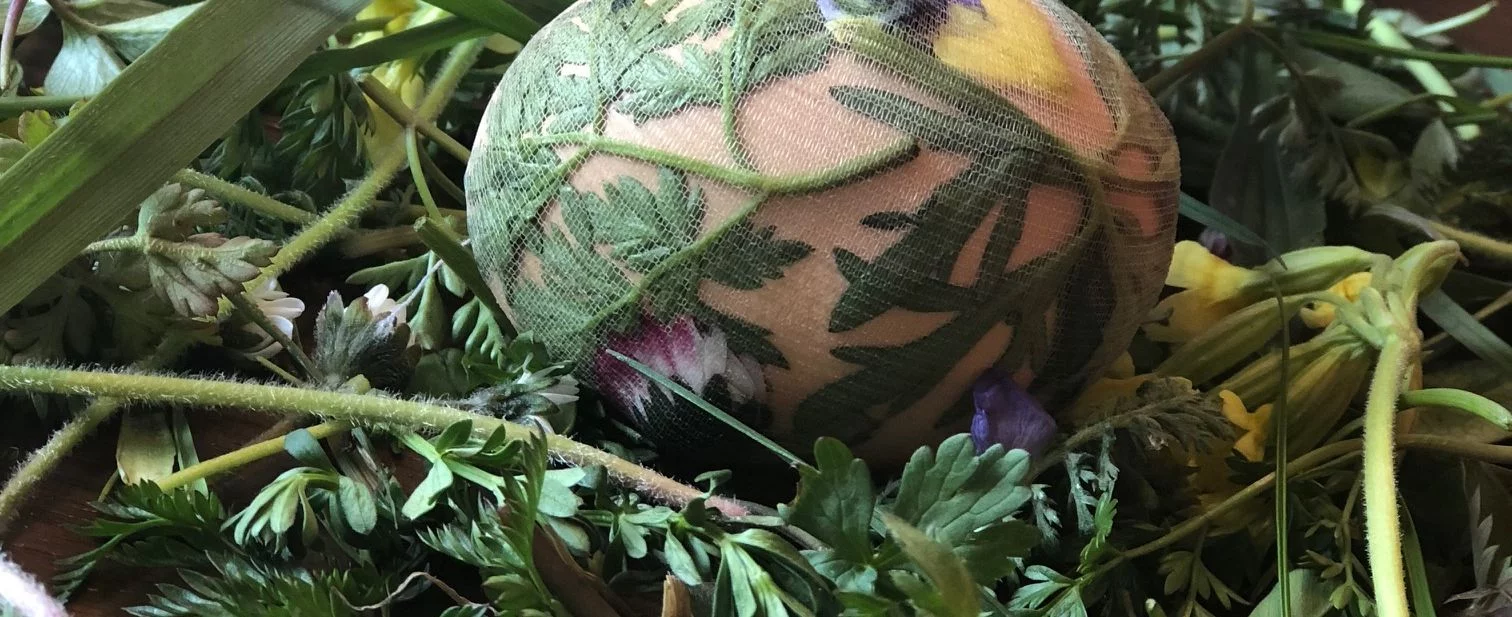
Herb eggs
How the beautiful herbal eggs are made
Easter eggs with a difference – traditional products from the Grossarl Valley
Prepare natural materials and co:
You need:
- Eggs in white
- Silk stockings
- Twine
- Scissors
- Egg dyes – we explain how to create your own natural dyes below
- Vinegar
- Herbs and flowers from the forest and meadow, as well as yellow onion skins
- Latex gloves and an old tablecloth
- Various cooking pots (one pot per color)
- some grease or oil and a soft cloth
You need silk stockings that are cut into pieces of the same size (old stockings with runny stitches get a new purpose! :-). The stockings should be cut into approx. 15 cm squares so that there is room for an egg and decoration. You should have chopped onion skins to hand as well as any herbs or flowers from the first spring flowers that are already blooming in the garden or forest. You should also have a string ready. When you start dyeing, it is best to use latex gloves so that the dye sticks to the eggs and not to your fingers. A carpet pad (e.g. old tablecloth) protects the tabletop from discoloration.
This is how the herb egg is made:
Place a piece of silk stocking on the table. Spread flowers, onion skins or herbs on it as desired. Then place a white egg on the stocking. The raw egg should be carefully coated with the herbs and the silk stocking. Whether you use a lot or a little herb, want to create a pattern or simply want to see what comes out, there are no limits to your imagination and creativity! The only important thing is that the decoration is tied tightly around the egg with the silk stocking so that the outlines of the herbs, flowers and onion skins stand out nicely on the surface of the egg. Then boil the eggs in colored water. We describe how to make your own natural dyes in the next paragraph. However, you can also use commercially available dyes. Pour a dash of vinegar into the water to give it a nice sheen and make the color stronger. Depending on your preference, choose a cooking time of 7 – 8 minutes for soft-boiled eggs and up to 10 minutes for hard-boiled eggs. As every stove is different, of course, you can rely on your usual egg cooking time. After cooking, carefully cut open the packets and marvel at the patterns that have emerged. Apply a little oil or fat to a soft cloth and rub the dyed eggs with it to give them a nice shine.
Make your own natural colors:
If you want your herbal eggs to be completely natural, then use colors from nature. There are many foods that give off natural color. For example, dried blackberries and elderberries give a blue hue, turmeric or dandelion give a yellow color, onion skins give a red-brown hue, spinach gives a green hue and red cabbage gives a purple hue. Beet produces a beautiful red to pink color. Boil the plant parts in a liter of water for approx. 20 – 45 minutes (each color in its own pot), then strain the broth and add a dash of vinegar. Boil the eggs in this colored brew. Ready-to-use natural dyes are also available from health food stores or well-stocked pharmacies.
We hope you have fun designing the herbal eggs! TIP: Children love decorating the eggs.